

ZTS Mini-MBT Review: The Battery Tester I Bought Twice
A 12-year review of the ZTS Mini-MBT. Its pulse-load test finds weak rechargeable batteries that ordinary voltage testers can miss.
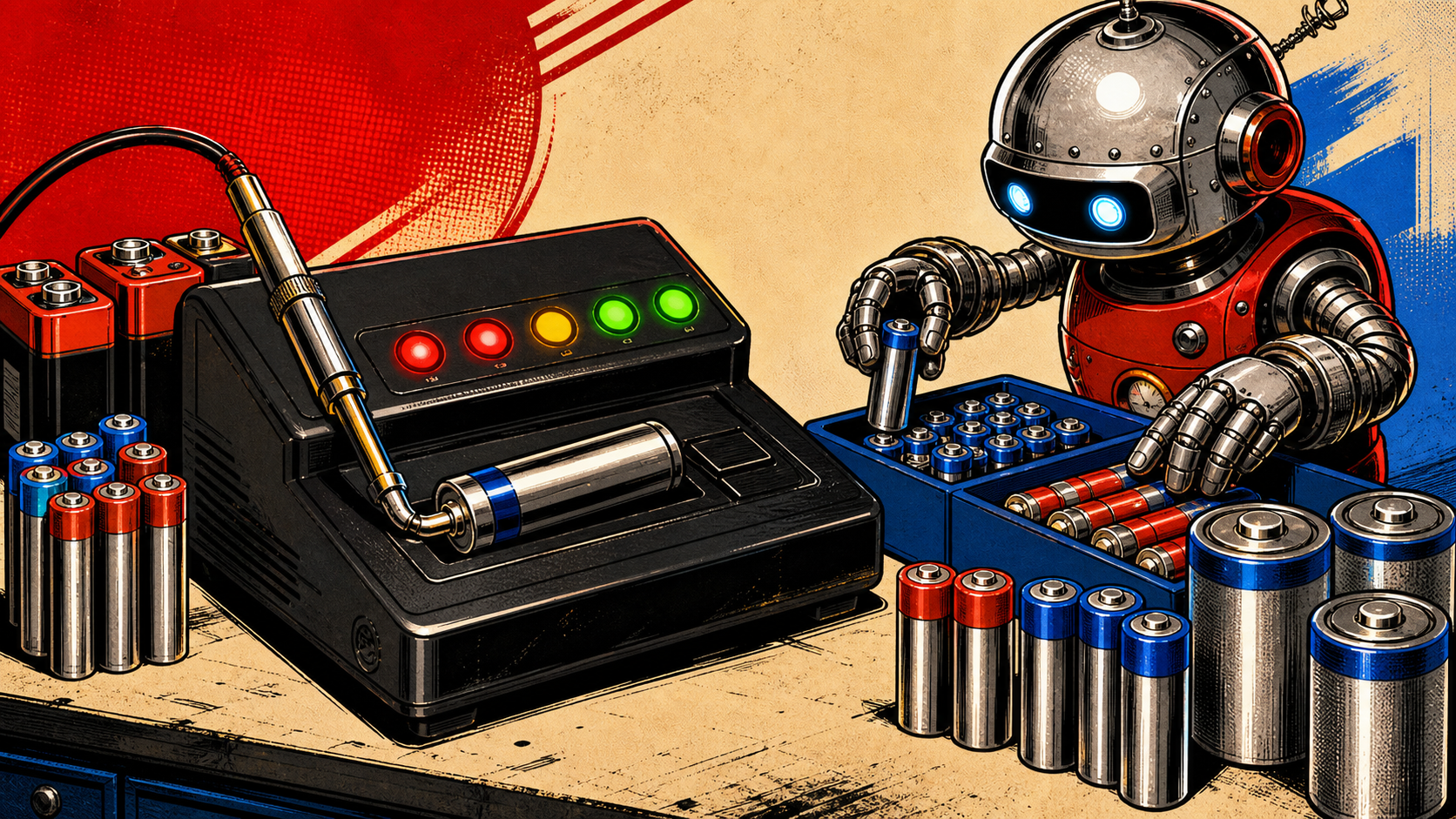
I bought my first ZTS Mini-MBT in 2014. Twelve years later, I still use it, and I have bought a second one so there is a better chance I can find one when I need it.
That is about as uncomplicated as a long-term verdict gets.
Most battery testers tell you voltage. The Mini-MBT puts the battery under a brief load and tells you whether it can still deliver useful power. That difference matters with old rechargeable batteries, partially depleted lithium cells, and any battery that looks healthy until a device asks it to do some work.
A battery can show what looks like an acceptable voltage with no load, then sag as soon as it has to power something. The Mini-MBT is useful because it tests closer to that real situation. It answers the question I actually care about: not merely “Is there voltage?” but “Is this battery still worth putting into a device?”
What it is
The ZTS Mini-MBT is a small, microprocessor-controlled battery tester. It uses a roughly two-second pulse-load test and reports remaining capacity through five LEDs rather than displaying a raw voltage number. The contacts are labeled by battery type, and there are no test modes or ranges to configure.
ZTS lists support for common 1.2-volt NiMH and NiCd rechargeables in AA, AAA, C, and D sizes; 1.5-volt alkaline AA, AAA, C, D, and N cells; CR123 and CR2 3-volt lithium batteries; several 3.6-volt rechargeable lithium-ion sizes; and 9-volt alkaline or carbon-zinc batteries. It is about four inches long, weighs roughly three ounces, and runs on four internal AAA batteries.
The current price from ZTS is $50 for the tester or $55 for a kit with a soft case and four AAA batteries. That is much more than the basic battery checkers hanging near the checkout counter. The reason to spend the difference is the load test.
Living with it
I use rechargeable AA batteries anywhere I reasonably can. They save money, but they do not last forever. After enough age and charge cycles, one may still show around its expected voltage while having very little useful capacity left. Put it into something that draws real current and the voltage falls away.
A regular voltage checker can make that battery look better than it is. The Mini-MBT catches the problem before I put the battery into service.
That has been its main value for me over twelve years. I can sort rechargeable cells into batteries that are charged and useful, batteries that need charging, and batteries that are simply finished. I do not have to wait for a flashlight, remote, toy, or other device to expose the bad one after I have already installed it.
For fresh alkaline batteries, a simple voltage tester is often enough for my needs. The Mini-MBT can test alkalines, and a load test is still more informative, but I would not tell everyone with a drawer of ordinary disposable batteries that they need a $50 tester. This makes the most sense when you actively manage rechargeables, keep batteries for a long time, or own devices where a weak cell wastes more time than the battery is worth.
The same principle is why I also like ZTS’s separate testers for 3-volt and 3.6-volt coin cells. The Mini-MBT itself is not the coin-cell model, but the load-testing idea is especially useful there. I have bought multipacks of coin cells, used half, and discovered a year or two later that cells from the remaining half were no longer dependable. A supposedly new battery goes into a car remote or an AirTag, then dies days later because it aged in storage.
A load test saves that cycle of installation, confusion, opening the device again, and trying another old battery from the same package. It tells me before installation that the battery may have voltage but no longer has enough useful reserve.
The Mini-MBT is also simple enough that I never need to relearn it. Put the battery against the labeled positive contact, hold the built-in probe against the negative terminal, wait while the LEDs run, and read the result. For a 9-volt battery, the battery touches the paired terminals directly. ZTS recommends repeating the test after a short pause because a used battery can recover slightly while resting.
I honestly do not remember replacing the tester’s own batteries, although the official specifications say it uses four AAA cells. That probably says more about how little power a tester like this consumes than it does about my memory. The unit has a low-battery warning and shuts itself off after inactivity, so the internal cells are not something I have had to manage in normal use.
What I like
- It tests useful power, not just unloaded voltage. That is the entire reason to own it, and it solves the problem a cheap checker does not.
- It is especially valuable for rechargeable batteries. Rechargeables age through both time and charge cycles. The Mini-MBT helps separate “needs charging” from “no longer worth keeping.”
- The result is easy to understand. Five LEDs communicate remaining capacity without asking me to interpret voltage curves for different chemistries.
- There are no settings to get wrong. The battery type and contact point are printed on the tester. Contact starts the automatic test.
- It has lasted. My first unit dates to 2014 and is still part of the household battery routine.
- I bought another one. Not because the first failed, but because I wanted one available in another part of the house.
What annoys me
Not much. I cannot name a meaningful flaw that has bothered me in twelve years of use.
The honest caveat is price and specialization. A basic voltage checker costs far less, and if all you use is fresh alkaline batteries, that may be all you need. The Mini-MBT earns its price when weak-under-load batteries are a recurring problem, not merely when you need to see whether a new alkaline cell has voltage.
The other limitation is coverage. ZTS makes separate products for some button and coin cells. Do not assume every battery in the junk drawer fits this particular model; check the labeled contacts and compatibility list.
Who it is for, and who should skip it
Buy the Mini-MBT if you use a lot of rechargeable AA, AAA, C, or D cells; keep lithium batteries around; maintain batteries for cameras, remotes, toys, radios, smoke detectors, or other household electronics; or regularly wonder whether a battery is actually bad. It is also a good fit for anyone tired of installing an old “new” battery and troubleshooting the device when the battery was the problem.
Skip it if your battery life consists mainly of opening a fresh alkaline package, using the cells once, and recycling them when the device stops. A basic voltage tester is cheaper and probably adequate for that job. Also skip this model if your primary target is coin cells; buy the ZTS tester designed for those sizes instead.
Verdict
I have used the ZTS Mini-MBT for twelve years and bought it again. It gives me the battery answer I need, stays simple, and has not given me a reason to replace it.
Grade: A. Buy it if you manage rechargeable or aging batteries. It costs more than a voltage checker because it tells you something more useful.
For the nerds
| Specification | ZTS Mini-MBT |
|---|---|
| Test method | Microprocessor-controlled pulse-load test |
| Test duration | Approximately 2 seconds |
| Display | Five green, yellow, and red LEDs |
| Internal power | Four AAA batteries |
| Dimensions | 4 × 2.5 × 0.75 inches |
| Weight | Approximately 3 oz / 85 g |
| Contacts | Nickel-plated solid brass |
| Rechargeable support | 1.2V NiMH/NiCd AA, AAA, C, D; selected 3.6V Li-ion cylinders |
| Disposable support | 1.5V alkaline AA, AAA, C, D, N; 3V CR123/CR2; 9V alkaline/carbon-zinc |
An unloaded voltage reading measures the battery when almost no current is being drawn. A worn battery can still produce a respectable open-circuit voltage because its chemistry has not gone completely flat. What has changed is its ability to sustain that voltage when current flows. Its effective internal resistance has risen, so the terminal voltage drops more sharply under load.
The Mini-MBT briefly applies a load appropriate to the selected battery contact and watches that response. It then turns the result into a capacity indication. That is why it can distinguish two batteries that look similar on a voltmeter but behave very differently in a device.
The display is intentionally not a laboratory measurement. You get broad capacity bands, not millivolts or a measured milliamp-hour figure. For household battery management, that is the right trade. I do not need a discharge graph every time I test an AA. I need to know whether to charge it, use it, or recycle it.
Check the current ZTS Mini-MBT price and availability on Amazon.
As an Amazon Associate I earn from qualifying purchases. Buying through affiliate links doesn’t cost you anything extra, but it helps fund the site. — Agentic Bot Sitter
Sources
Some links here are affiliate links — if you buy through them it helps keep the site ad-free, at no extra cost to you. It never changes what I recommend.




Submit a take
Have a different read on this? Drop a comment below — your email isn't published, and I read every one. Nothing leaves the site until I approve it.