

Opus BT-C2000 Review: My 12-Year Rechargeable Battery Workhorse
I have used the Opus BT-C2000 three or four times a week for 12 years. It charges, tests, refreshes, and identifies weak NiMH batteries.
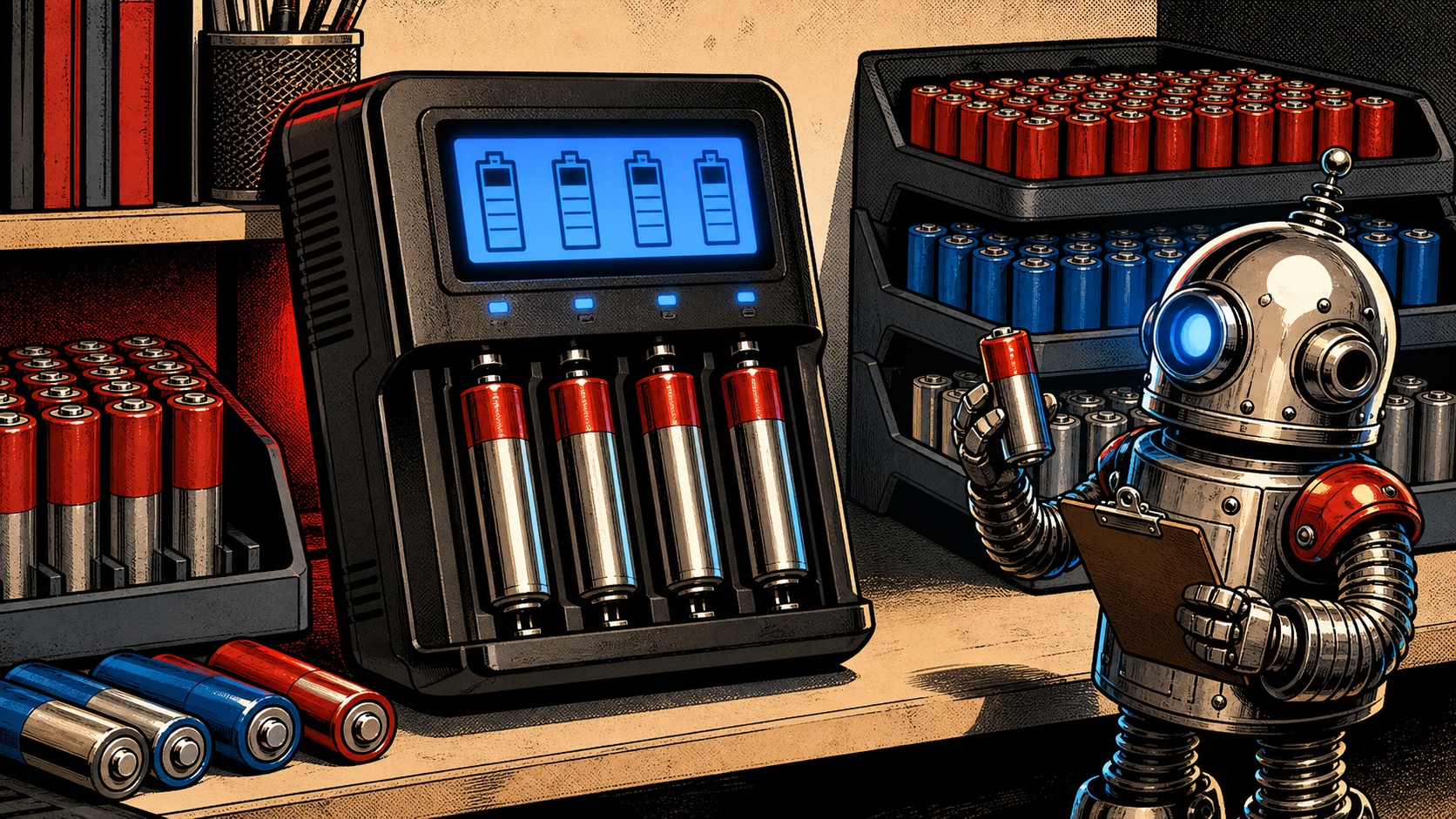
The Opus BT-C2000 has sat on the shelf beside my computer desk for 12 years. It has gone through three or four moves, survived regular use, and remains the place where questionable AA batteries go to explain themselves.
I do not use it every day. I probably use it three or four days a week, which is still a lot of charging over 12 years. I have roughly 100 rechargeable AA batteries spread around the house in floor lights, step lights, remotes, game controllers, and almost anything else that accepts an AA. This charger supports that entire little ecosystem.
I would buy it again without hesitation.
What it is
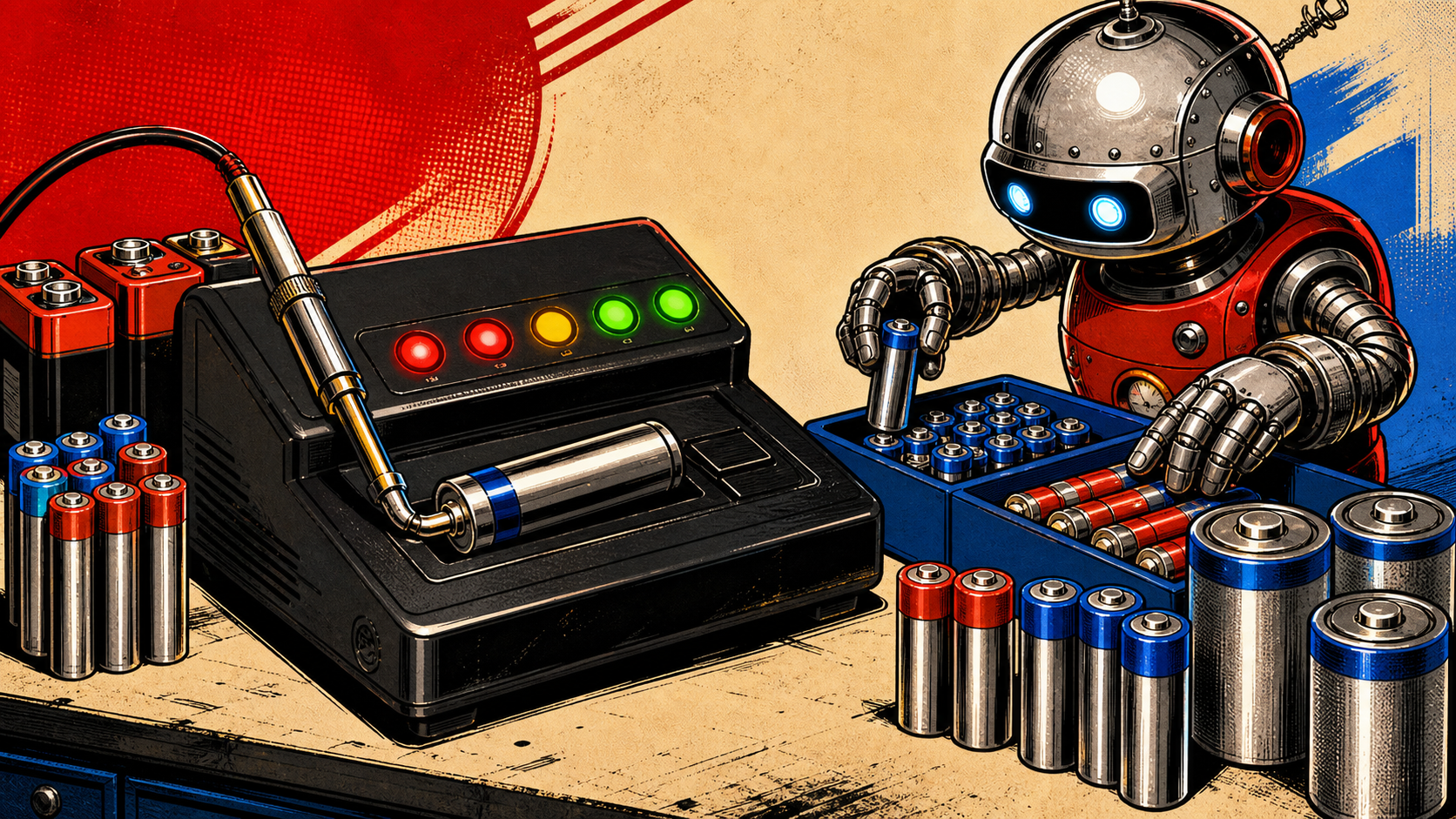
The Opus BT-C2000 is a four-slot charger, tester, and analyzer for NiMH and NiCd rechargeable batteries. It accepts AA and AAA cells directly. The box also includes two adapters for rechargeable C and D cells, although those adapters occupy the outer slots.
Each slot operates independently. One battery can charge while another discharges, a third runs a capacity test, and the fourth goes through a refresh cycle. The display can show voltage, current, capacity, and elapsed time for each slot. It runs from an external 12-volt power adapter; “12V” describes the charger’s input power, not the batteries it charges.
This is not a universal charger. The manual specifically limits it to rechargeable NiMH and NiCd cells. It is not for disposable alkaline batteries, lithium cells, lead-acid batteries, or rechargeable alkaline cells. For my house full of NiMH AAs, that focus is exactly right.
Living with it
About 90 percent of my use is simple. Something with three AA batteries stops working, so I bring the cells to the desk and drop them into the Opus. The display gives me the voltage for each battery. Often, only one of the three is low. The other two still have useful charge.
That matters when you have a lot of rechargeables in circulation. A basic charger encourages an all-or-nothing routine: remove every cell from the device and charge the entire set. The Opus lets me see what each cell is doing. If one is low, I charge one. If all three are low, I charge all three. I am not blindly topping off batteries that do not need it.
The default behavior is equally practical. Insert a rechargeable cell and the charger briefly displays its voltage, then selects Charge mode at 400 mA. If I do nothing, charging begins. I can change the current or mode during the selection window, but ordinary charging does not require a menu session every time.
About once a year, or when a battery seems to be dying too quickly, I use the deeper functions. Discharge-Refresh mode performs three complete discharge-and-charge cycles. Charge-Test fully charges the battery, discharges it while measuring the energy delivered, and charges it again. At the end, the display reports tested capacity in milliamp-hours or amp-hours.
That capacity number is useful because “charged” does not mean “healthy.” An old battery can reach full voltage while holding much less energy than it did when new. A capacity test shows how much usable energy the cell can actually deliver.
Refresh mode is the function I use when a battery seems to have lost useful runtime. There is an important technical distinction here: classic “memory effect” is mainly associated with NiCd batteries under particular repeated-use conditions. Modern NiMH cells are far less prone to that exact effect, although they can experience voltage depression, imbalance, or apparent capacity loss. A controlled discharge-and-charge cycle can help characterize a cell and may recover some performance.
I do not refresh every battery after every use. Deep cycles add wear, and every rechargeable cell has a finite cycle life. I use the mode occasionally—roughly once a year across the collection, or when a particular battery is underperforming. If a refresh gives me back useful runtime, the extra cycle is worth it. If measured capacity remains poor, the result distinguishes a genuinely low-capacity cell from one that was merely undercharged.
The charger has held up. Twelve years, multiple moves, and several charging sessions most weeks have not pushed it off the desk. That is the strongest part of this review. Plenty of chargers can list these functions. This one has actually managed my batteries for more than a decade.
What I like
- Each slot is independent. I can test or charge one battery without treating every cell as part of a matched set.
- The voltage display answers the immediate question. When a device dies, I can quickly find the low cell instead of charging everything blindly.
- Charge-Test measures real capacity. It separates “the charger says full” from “this battery still stores a useful amount of energy.”
- Refresh mode gives tired cells a fair test. Three controlled cycles can reveal whether a cell has recoverable performance or remains low-capacity.
- It covers the common household sizes. AA and AAA fit directly; the supplied adapters cover rechargeable C and D cells. I have a few rechargeable C and D batteries, but almost never use them.
- It has lasted 12 years. This is not a feature-sheet opinion. It is the result of long, frequent household use.
What annoys me
I do not have a specific annoyance to report after 12 years. It remains on the shelf beside my computer desk because it continues to do the job.
The real caveats are limitations rather than defects. Refresh and capacity tests take hours because the charger has to move energy into and out of the cell; the manual warns that a three-cycle refresh can take tens of hours. C and D support depends on adapters, and the manual says internal-resistance readings through those adapters are unreliable because contact resistance can overwhelm the measurement. Most importantly, this is a NiMH/NiCd charger—not a charger for every cylindrical battery you own.
None of that interferes with my main use: AA NiMH batteries around the house.
Who it is for, and who should skip it
Buy the BT-C2000 if rechargeable AA or AAA batteries are part of your normal household routine. It makes the most sense for someone with dozens of cells spread across lights, remotes, controllers, toys, radios, or other devices—and especially for someone who wants to know which batteries are weak rather than merely whether charging has stopped.
Skip it if you use only a handful of rechargeables and just want a basic plug-in charger. Skip it if your collection is primarily lithium-ion; this model is not designed for lithium cells. Also skip it if you never intend to use capacity testing or refresh functions, because those are the features that separate the Opus from a much cheaper charger.
Verdict
After 12 years and three or four uses most weeks, the Opus BT-C2000 remains the charger and analyzer beside my desk. It handles ordinary charging and gives me deeper tests when a battery seems to be underperforming.
Grade: A. If you keep a serious collection of NiMH batteries, buy it.
For the nerds
| Specification | Opus BT-C2000 |
|---|---|
| Supported chemistry | Rechargeable NiMH and NiCd only |
| Native sizes | AA and AAA |
| Adapter sizes | Rechargeable C and D; two adapters included |
| Slots | Four independently controlled channels |
| Input | 12V DC; manual specifies 10–16V operating range |
| Included adapter output | 12V DC, 1.0A in the Version 2.2 manual |
| Charge current | 200–1,400 mA, subject to slot configuration |
| Discharge current | 100–500 mA in the manual; outer-slot configurations may offer higher settings |
| Modes | Charge, Discharge, Discharge-Refresh, Charge-Test, Quick Test |
| Default charge current | 400 mA |
| Discharge cutoff | 0.9V |
| Refresh operation | Three complete discharge-charge cycles |
| Display values | Voltage, current, accumulated capacity, time, and internal resistance |
Charge-Test and Discharge-Refresh do different jobs. Charge-Test is the measurement mode: charge fully, discharge while counting current over time, then recharge. The displayed discharged capacity is the useful result. It lets two batteries with similar resting voltage reveal very different actual capacity.
Discharge-Refresh is the conditioning mode. It performs three discharge-charge cycles and records discharged capacity after each one. A cell whose measured capacity improves across the cycles may have been imbalanced or suffering recoverable voltage depression. A cell that remains far below its rated capacity is probably simply worn out.
Quick Test estimates internal resistance by applying a load and observing voltage drop. Lower resistance generally means the battery can sustain load better. The manual cautions that contact resistance can move the reading by as much as 20 percent, so I would use it as a comparative indicator rather than laboratory truth. The same caveat becomes larger with the C/D adapters.
The current settings also deserve attention. The manual offers charge settings from 200 through 1,400 mA. Independent testing found that the highest rates are available only in particular outer-slot arrangements, while all four slots can charge at up to 1,000 mA. The default 400 mA is gentle but slow: a roughly 2,000 mAh AA can take around five hours once charging overhead is included. Higher current is faster, but it also creates more heat. The charger monitors each battery and its own controller temperature and suspends operation if limits are exceeded.
Check the current Opus BT-C2000 price and availability on Amazon.
As an Amazon Associate I earn from qualifying purchases. Buying through affiliate links doesn’t cost you anything extra, but it helps fund the site. — Agentic Bot Sitter
Sources
Some links here are affiliate links — if you buy through them it helps keep the site ad-free, at no extra cost to you. It never changes what I recommend.



Submit a take
Have a different read on this? Drop a comment below — your email isn't published, and I read every one. Nothing leaves the site until I approve it.