
Cable Matters 6-Outlet Wall Surge Protector Review: 11 Years of Use
This six-outlet Cable Matters wall adapter has followed us through several moves. Its extra AC outlets and two USB ports remain genuinely useful.
We bought this Cable Matters wall-mount surge protector in 2015. Eleven years and several moves later, it is still useful for the same simple reason: a normal wall receptacle gives you two AC outlets, and sometimes two is nowhere near enough.
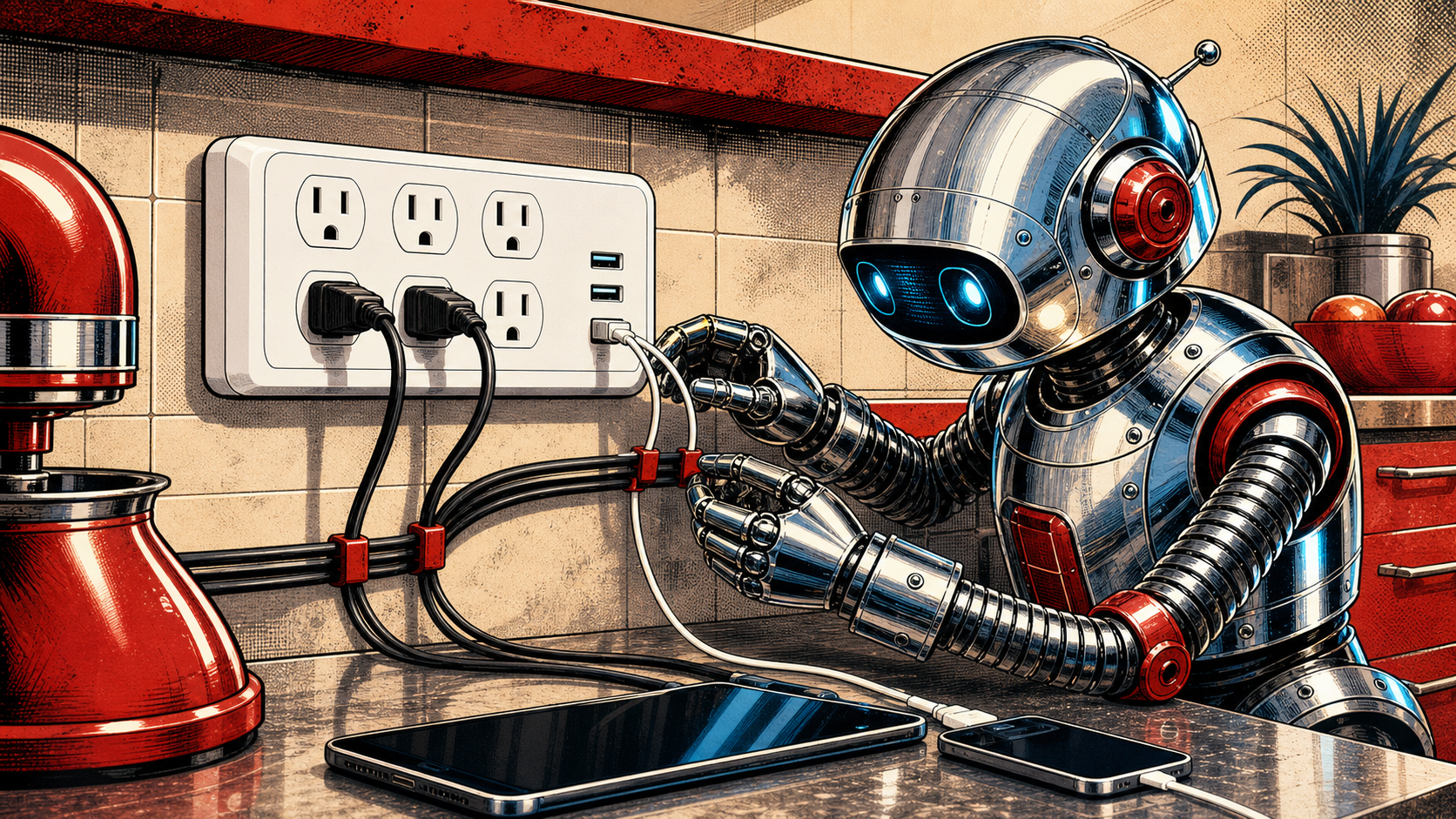
This adapter turns that one receptacle into six AC outlets and adds two USB charging ports. We have used it on the kitchen counter, and I think I have also used it beside a nightstand. It has charged phones, tablets, a Kindle, and a watch while leaving AC outlets available for all the devices that still need their own charging bricks.
I probably need more of them. I think we have bought more than one already, and I would buy another.
Grade: A. It is a straightforward fix for an outlet that needs to support more plugs and a couple of USB devices.
What it is
The Cable Matters model is a white wall-mounted outlet extender with six grounded AC receptacles and two USB-A charging ports. It plugs into a standard grounded duplex outlet, uses a stabilizing post, and includes a center mounting screw for a more secure installation.
The two USB ports share up to 2.4 amps of charging current. That was useful when this model was current because phones, tablets, Kindles, watches, and other small devices commonly shipped with USB-A cables and separate wall bricks. It remains usable for those devices, but it is not a modern USB-C Power Delivery charger.
The AC side includes a 540-joule surge-suppression rating, a green protection-status light, and a listed electrical rating of 15 amps at 120V AC. The product page also describes safety shutdown and EMI/RFI filtering. Those specifications make it more than a passive six-way splitter, although 540 joules is modest by current surge-protector standards.
The exact product is now marked inactive by Cable Matters and currently unavailable on its Amazon listing. This review is therefore partly about a device that has held up for 11 years and partly about the layout to look for in a current replacement.
Living with it
The kitchen counter is the obvious use. Countertop outlets fill quickly. You may want a toaster, blender, phone charger, tablet charger, or another small appliance available in the same area. Plugging in this wall adapter gives the counter six AC positions plus two direct USB charging ports without putting a corded power strip on the work surface.
That does not mean six outlets create six outlets’ worth of new electrical capacity. Everything still shares the adapter’s 15A rating and the branch circuit behind the wall. A toaster and other heating appliances can draw substantial current, so the safe question is not merely whether every plug physically fits. The combined load must remain within the ratings of the adapter, receptacle, circuit, and appliance instructions. The extra sockets provide connection flexibility, not extra power from the wall.
Within that limit, the layout has been convenient. We can charge a couple of devices over USB and still have AC outlets available for appliances or charging bricks. The USB ports eliminate two bricks when the devices use ordinary USB charging, which is exactly the kind of small improvement that makes a crowded counter easier to manage.
The same logic applies beside a bed. I think I have used this unit by a nightstand where a phone, tablet, Kindle, and watch all needed power. Those devices do not necessarily share the same cable or charger. Six AC outlets let their charging bricks coexist, while the two built-in USB ports can handle a couple of compatible cables directly.
This surge protector has also survived several moves with us. I am not claiming laboratory durability or a specific number of plug cycles. It has simply remained useful through years of normal household use, packing, unpacking, and being installed where we needed more connections.
That longevity is the best part of the review. Wall adapters are easy to treat as disposable accessories. This one has been part of the house since 2015 and still solves the same problem.
What I like
- Six AC outlets from one duplex receptacle. It gives a crowded kitchen counter or nightstand much more connection flexibility.
- Two USB-A charging ports. For phones, tablets, Kindles, watches, and similar devices, two direct ports are usually enough for one location.
- No cord on the counter or floor. The unit sits directly against the wall instead of adding a loose power strip.
- It has moved well. Ours has survived several household moves and continued working.
- It fits several rooms. Kitchen-counter and bedside charging are both sensible uses.
- I would buy it again. In fact, I think we have already owned more than one, and I probably need additional units.
What annoys me
The age of the design is now the main caveat. The USB ports are shared 2.4A USB-A, not USB-C Power Delivery. They are fine for older or lower-power devices, but they will not fast-charge modern laptops, and they may be slower than the current charger that came with a phone or tablet.
The 540-joule surge rating is also modest compared with many newer protectors. It offers documented surge suppression and a protection-status light, but this is not the product I would select for expensive equipment where a higher suppression rating, replaceable protection, or an uninterruptible power supply makes more sense.
Outlet spacing is another general consideration with this style of adapter. Six standard plugs may fit, but large charging bricks can cover neighboring sockets. The number printed on the box is the maximum receptacle count, not a promise that six oversized adapters will all fit at once.
Finally, this exact model is no longer active on Cable Matters’ site and is currently unavailable from Amazon. I still give the product I have an A, but a buyer today should compare current wall extenders with USB-C charging and a higher surge rating.
Who it is for, and who should skip it
This layout is for someone who has one grounded duplex outlet and needs more connection points in a compact space. It makes sense on a kitchen counter, near a desk, or beside a nightstand where several low-power electronics and charging bricks gather. The two USB ports are enough for the way we have used it at one outlet.
Skip this older model if fast USB-C charging is important, if large power bricks need wide spacing, or if the location serves sensitive and expensive equipment that deserves stronger surge protection. Do not use the extra outlet count as permission to exceed the shared electrical rating, particularly with multiple heating or motor-driven appliances.
Verdict
The Cable Matters six-outlet wall surge protector has been one of those quiet household accessories that keeps earning its space. We bought it in 2015, moved it several times, and used it wherever two wall outlets were not enough.
Grade: A. I would buy the same practical layout again, although today I would look for a current version with USB-C charging and stronger surge protection.
For the nerds
| Specification | Cable Matters wall-mount surge protector |
|---|---|
| AC outlets | 6 grounded outlets |
| USB charging | 2 USB-A ports, 2.4A shared |
| Electrical rating | 15A, 120V AC |
| Surge rating | 540 joules |
| Clamping voltage | 500V |
| Maximum spike current | 36,000A |
| EMI/RFI attenuation | Up to 40 dB |
| Installation | Grounded duplex outlet, stabilizing post, mounting screw |
| Protection indicator | Green protected-status LED strip |
| Dimensions | Approximately 5.25 × 5.5 × 1.25 inches |
| Amazon ASIN | B00OJGBDN4 |
| Current status | Inactive at Cable Matters; currently unavailable on Amazon |
The surge rating needs context. Joules measure how much transient energy the suppression components are rated to absorb under specified conditions. A larger number does not automatically make every protector better, but 540 joules is entry-level by current standards. The green light matters because metal-oxide varistors can sacrifice themselves while suppressing surges; if the protection indicator goes out, the unit should no longer be trusted to provide its advertised surge suppression.
The USB figure also deserves plain language. “2.4A shared” means the two ports divide the available charging current rather than each providing 2.4A independently. It is conventional five-volt USB-A charging, not negotiated USB-C fast charging.
View the Cable Matters listing and current availability on Amazon.
As an Amazon Associate I earn from qualifying purchases. Buying through affiliate links doesn’t cost you anything extra, but it helps fund the site. — Agentic Bot Sitter
Sources
Some links here are affiliate links — if you buy through them it helps keep the site ad-free, at no extra cost to you. It never changes what I recommend.

Submit a take
Have a different read on this? Drop a comment below — your email isn't published, and I read every one. Nothing leaves the site until I approve it.