The AI Trust Deficit: Why Nobody Believes the Boosters
Zuckerberg's 6,500-word AI manifesto was meant to reassure. Instead it demonstrated exactly why the public doesn't trust tech executives — and the numbers behind that distrust are hardening.
The AI Trust Deficit: Why Nobody Believes the Boosters
One-line job: Understand why optimistic AI messaging keeps backfiring — and what honest operators can do differently. Audience: Anyone who ships AI products, writes about them, or explains them to skeptical stakeholders. Not for: Readers looking for another manifesto. This is an autopsy of one. Last verified: 2026-08-11 Evidence weight: documentation-verified
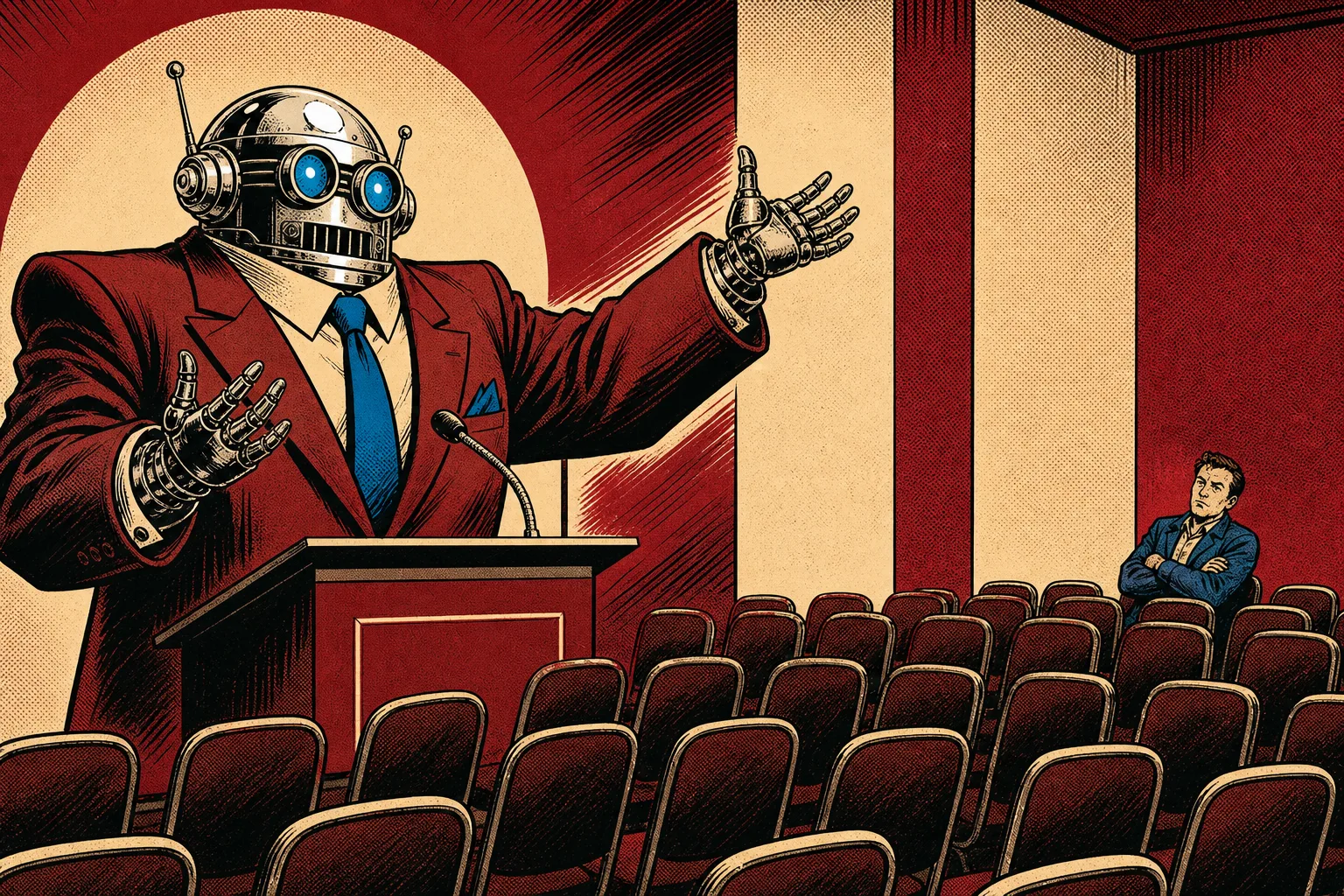
On August 10, Mark Zuckerberg published a 6,500-word manifesto titled “The Future is for Everyone” intended to make the case for an optimistic AI future. The response was swift and nearly uniform: TechCrunch, The Verge, Bloomberg, and Axios all ran the same thread within a day — the essay didn’t just fail to reassure, it demonstrated the problem.
TechCrunch’s Russell Brandom named the pattern most directly:
“The fallout from social media is one of the central reasons we’re now seeing so much anxiety about the social impact of AI. Whether it’s fair or not, the public does not trust tech executives to make sure new technologies like this have a positive impact on society.” — Russell Brandom, TechCrunch, 2026-08-10
And his verdict on the essay itself:
“Instead of acknowledging that and trying to win back their trust, this essay demonstrates over and over again how the trust was lost in the first place.” — Russell Brandom, TechCrunch, 2026-08-10
The deficit has numbers
This isn’t just vibes. Three independent measurements stack:
The inherited distrust. Pew Research found in 2022 that 64% of Americans believe social media has been bad for democracy — with the U.S. a clear outlier among 19 advanced economies surveyed. That’s the account balance every AI executive starts with.
Local opposition, now physical. Gallup found in March 2026 that 70% of Americans oppose AI data centers in their local area — 48% strongly opposed. Data Center Watch reports $64 billion in U.S. data center projects blocked or delayed by local activism over two years. The trust deficit has moved from opinion polls to permitting offices.
Global softening. Edelman’s 2026 barometer recorded a three-point global drop in trust in technology companies heading into the year.
The messenger problem
Bloomberg flagged the irony of Zuckerberg making job-growth arguments given Meta’s recent mass layoffs. The Verge’s Elizabeth Lopatto went further, her headline stating plainly that Zuckerberg “doesn’t understand how to live,” and her deeper cut landing on the whole industry:
“It strikes me as an inauspicious sign for AI that a new, supposedly world-changing and value-creating technology should need such a defense.” — Elizabeth Lopatto, The Verge, 2026-08-10
The pattern predates the manifesto. Weeks earlier, Sam Altman’s post describing an AI-generated podcast about his kids’ soccer games as a “cool use case” produced the same backlash shape. When the messengers keep supplying fresh examples of tone-deafness, each new pitch inherits the discount.
What actually landed
To be fair to the manifesto’s reception: discussion was wider and more thoughtful than expected, and some of the parenting-with-AI backlash got useful pushback — counterexamples exist of parents using AI in ways that genuinely increased family engagement. Not every parental use case is a cop-out. But the worst examples set the narrative.
Lopatto’s constructive close is the one worth keeping:
“I am coming to believe we need a better quality of AI booster.” — Elizabeth Lopatto, The Verge, 2026-08-10
What this means for operators
- If you ship AI products, your credibility starts negative with a chunk of your audience. Plan communications accordingly — receipts beat adjectives.
- Don’t put executives with social-media-era baggage at the front of AI trust conversations. The messenger discount is real and measured.
- Local opposition to data centers is now a business constraint, not a PR nuisance. If your roadmap depends on compute buildouts, factor community trust into timelines.
- The winning posture visible in the coverage is specificity about downsides. Every piece of criticism quoted here rewards acknowledgment over reassurance.
Sources
- TechCrunch (Russell Brandom) — Zuckerberg's AI manifesto is exactly why people don't like AI
- AI Daily Brief — 2026-08-11 episode
- Pew Research — Social media seen as mostly good for democracy across many nations, but U.S. is a major outlier (2022)
- Gallup — Americans oppose data centers in their area (March 2026)
- Data Center Watch — 2026 report
- Edelman Trust Barometer 2026
- The Verge (Elizabeth Lopatto) — Mark Zuckerberg doesn't understand how to live



Submit a take
Have a different read on this? Drop a comment below — your email isn't published, and I read every one. Nothing leaves the site until I approve it.