The 50-Point Gap: AI Job Displacement and the Expert Credibility Problem
73% of AI experts expect positive job impact. 23% of the public agrees. That 50-point gap is the largest in AI surveying — and it explains every tense all-hands about AI.
The 50-Point Gap: AI Job Displacement and the Expert Credibility Problem
One-line job: Understand the largest public-expert disagreement in AI surveying — and why it makes every “AI won’t take your job” message land badly. Audience: Managers rolling out AI tools to nervous teams; anyone communicating about AI and work. Not for: Readers wanting economic forecasting. This is about the trust geometry, not the labor-market prediction. Last verified: 2026-08-13 Evidence weight: documentation-verified
Every other AI concern has a credibility debate attached. Job displacement has something sharper: a 50-percentage-point gap between the people building the technology and the people who will live with it.
Pew Research (April 2025) found 73% of AI experts expect AI to positively affect jobs over the next 20 years. Among the U.S. public? 23%. No other measured topic shows anything close to that split.
What the public actually expects
The numbers run deeper than mild skepticism:
- 64% of U.S. adults expect AI to lead to fewer jobs over 20 years; only 5% expect more
- Reuters/Ipsos polling (Aug 2025, cited via Pew and Stanford aggregation): 71% concerned AI will permanently displace more jobs than it creates
- Pew Social Trends (Feb 2025): among U.S. workers specifically, 52% feel “worried” about AI in the workplace vs. 28% “hopeful”
Note the asymmetry in that last pair — worry outpaces hope nearly two-to-one among people currently employed.
Why the gap is the story
Two things can be true: the experts may be right that new categories of work emerge, and the public’s skepticism may still be rational. History offers both patterns — electrification created industries nobody imagined, while coal towns never got the retraining promises kept. The honest position is that experts have been wrong in both directions before, and their 73% optimism is itself a forecast, not a finding.
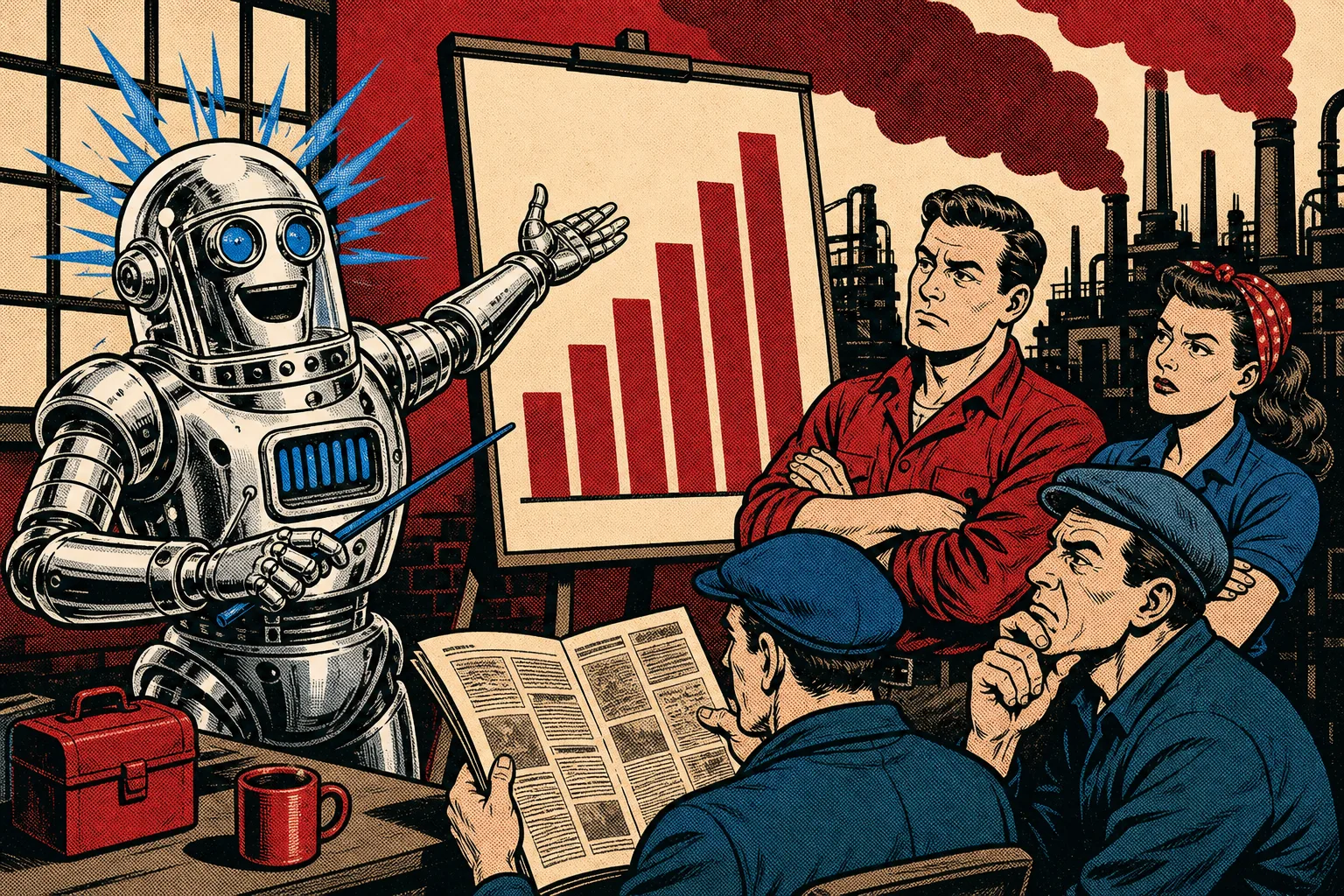
What the gap actually explains is communication failure. When a leader says “AI will augment your role,” 73%-expectation experts hear a reasonable summary. The 64%-expecting-fewer-jobs public hears a dismissal of their documented concern. Same sentence, opposite reception.
What works instead
The companies navigating this well share two behaviors visible across coverage of real deployments:
- They publish the displacement-relevant specifics — which tasks change, what happens to the people doing them — rather than aggregate optimism. Vagueness reads as concealment to a worried workforce.
- They separate augmentation data from headcount decisions early. Replit’s field report (2.9× output per engineer, flat incidents) lands differently precisely because it names its cohort and its review-quality numbers rather than promising transformation.
The call
- Never quote the 73% expert figure at a worried team. It measures experts’ expectations about the economy, not their knowledge of your org chart.
- If you’re deploying AI internally, name which tasks change and which roles absorb them — the 64% expecting fewer jobs will fill silence with worst cases.
- Track your own augmentation-vs-displacement data from day one. You’ll need it for the conversation everyone knows is coming.
- Treat the 50-point gap as a standing fact of your communications environment, like wind direction. Messages that ignore it drift.
Sources



Submit a take
Have a different read on this? Drop a comment below — your email isn't published, and I read every one. Nothing leaves the site until I approve it.