The Capability-to-Context Shift
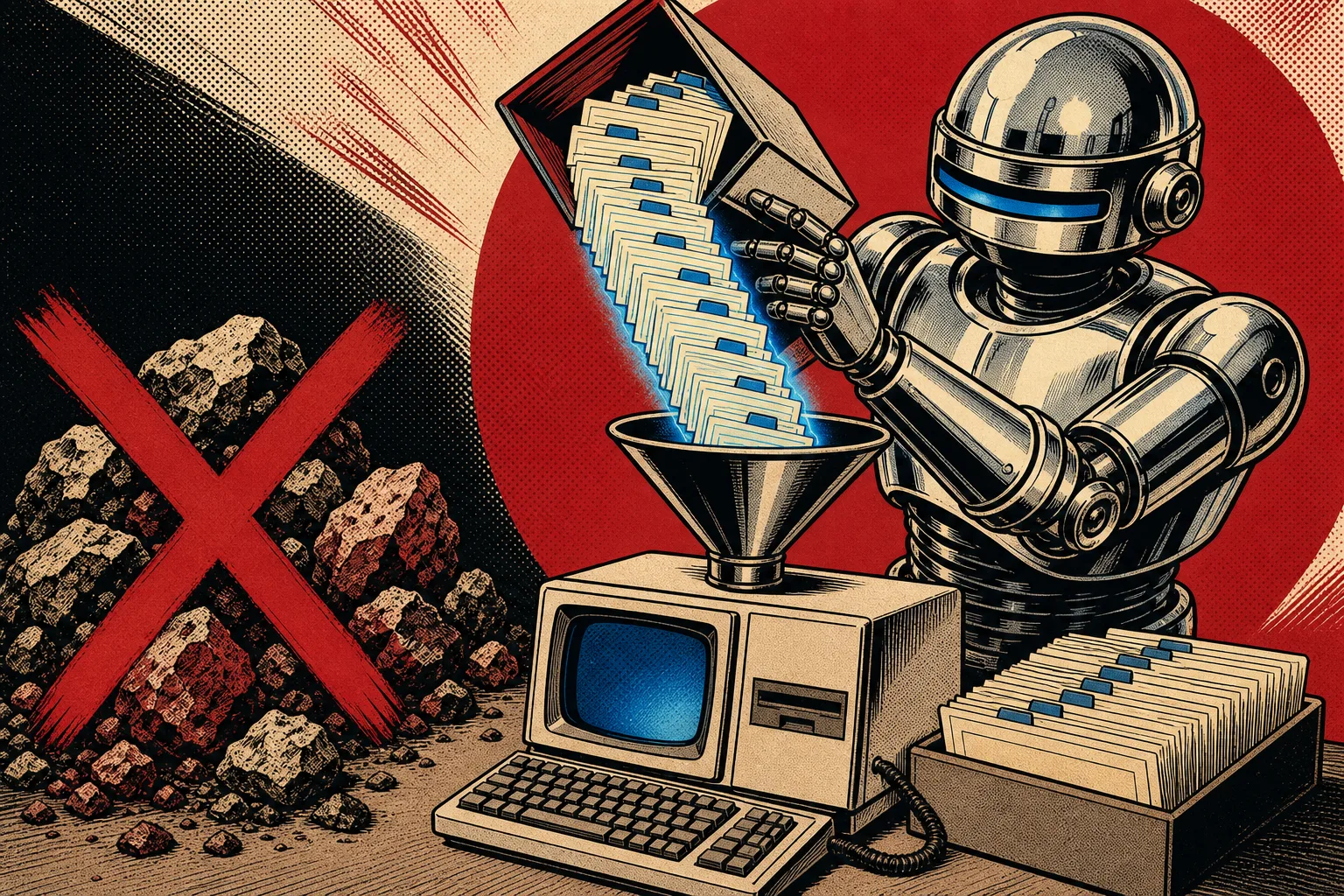
Frontier models got good enough that the binding constraint moved. The operators winning in 2026–2027 are the ones closing context gaps, not chasing capability.
The Capability-to-Context Shift
One-line job: Apply one filter to every AI product and project you touch this year — does it close a context gap, or just add more capability on top of one? Audience: Operators deciding where AI effort goes next quarter. Not for: Anyone shopping for a model comparison — models are the part this thesis says is no longer the problem. Last verified: 2026-08-21 Evidence weight: documentation-verified
Here’s a correction before anything else: this idea isn’t new. It has a 2023 academic lineage and was formalized in mid-2025. What happened recently is that it got named — twice, independently, within weeks of each other — and that double-naming is why it’s suddenly everywhere.
Nathaniel Whittemore named it on the August 14 AI Daily Brief episode:
“The bottleneck in AI has moved from model capability to access to context.” — Nathaniel Whittemore, AIDB 2026-08-14
Three months earlier, Patrick Debois of Tessl had called the same shift “Context Is the New Code” at AIE London. When two people who don’t coordinate name the same thing the same way, pay attention.
What the thesis actually claims
Not that models stopped mattering — that they got good enough to stop being the binding constraint. What limits your AI results now is what the model doesn’t know about your situation:
“Just because a model can do something doesn’t mean it has the information and context it needs to do it well relative to you personally.” — Nathaniel Whittemore, AIDB 2026-08-14
Atlan’s Prukalpa Sankar defines context as three things: knowledge, expertise, and norms. Her enterprise observation is the sharpest articulation of the failure mode:
“Anyone who’s used AI in an enterprise context has noticed that as the model improves, work often gets re-bottlenecked by the lack of different kinds of context.” — Prukalpa Sankar, Insight Partners, 2026-08-19
And her team’s war story gives the thesis its best number. An AI system stuck at 70% accuracy turned out not to need a better model:
“We could never get accuracy above 70%… What we realized was that the accuracy ceiling wasn’t a model problem but a context problem.” — Prukalpa Sankar, Insight Partners, 2026-08-19
Why context is finite (the technical half)
Two research anchors make this more than a vibe. Liu et al.’s 2023 “Lost in the Middle” paper showed models retrieve information worse when it sits mid-context. Chroma’s July 2025 Context Rot study generalized it across 18 LLMs: performance degrades as input length increases — non-uniformly, even on tasks of constant complexity.
Anthropic’s engineering post operationalized the consequence: treat context as a finite resource with diminishing marginal returns. More tokens in doesn’t mean better output out.
Which kills the easy answer:
“Infinite context windows do not save you, they make conflicts worse, not fewer. Curation becomes governance.” — Kushal Banda, writing up Debois’s talk, Towards AI, 2026-05-04
Bigger windows mean more opportunities for contradictory guidance — and agents don’t flag conflicts. They silently pick one.
Two products that prove the point
The thesis got concrete this month. GrokBot’s teach-a-task (xAI, 2026-08-11) attacks the deliberate half: record yourself doing a workflow, get back a reusable skill. ChatGPT’s Computer History (OpenAI, 2026-08-13) attacks the ambient half: it observes your activity across apps and builds ongoing context from interaction events. Neither adds model capability. Both close context gaps. That’s the tell about where the market thinks the bottleneck is.
The filter
So here’s the heuristic I’d actually use — offered as a useful frame, not a validated rubric: for every AI product or internal project you evaluate this year, ask whether it closes a context gap or merely stacks capability on top of an unsolved one.
Memory features close gaps. Ambient observation closes gaps. Skill authoring, retrieval, enterprise knowledge layers, harness engineering — all gap-closers, all compounding. A smarter model pointed at a context-starved workflow plateaus exactly the way Sankar’s 70% ceiling did: impressive pilot, stalled production.
Debois’s flywheel argument explains the compounding side — better context produces better output, which produces better signals, which produces better context. And his moat claim is the strategic kicker: refined organizational context can’t be downloaded by a competitor the way a model can.
Honest limits
Three things this thesis does not claim. Models still matter — capability had to clear a bar before context became the constraint, and frontier differences still show at the edges. The “dominant operator frame for 2026–2027” framing is my synthesis of these sources, not a measured consensus. And nothing here is solved: the CDLC, Anthropic Skills, Atlan’s context layer, and LangChain’s harness work are all partial answers to different slices of the same gap.
The call
- Audit last quarter’s AI disappointments. Count how many were model problems versus context problems. Be honest about the ratio.
- Inventory what your AI tools actually know about your business versus what lives only in your head and your Slack history.
- Before buying any 2026–2027 tool, run the filter: gap-closer or capability-stacker?
- Start curating now. Curation-as-governance sounds abstract until your agent acts on a six-month-old convention nobody corrected.
- Revisit in six months — if the thesis holds, the winning products will be the ones that made your context richer without you doing the data entry.
Sources
- AI Daily Brief, 2026-08-14 episode
- AIDB 2026-08-14 transcript
- Patrick Debois — Two Weeks After Context Is the New Code (Tessl)
- Patrick Debois — Context Is the New Code (AIE London talk)
- Insight Partners — The Context Layer for Enterprise AI
- Anthropic — Effective context engineering for AI agents
- Chroma — Context Rot research, 2025-07
- Liu et al. — Lost in the Middle (arXiv, 2023)
- Kushal Banda — Context Is the New Code writeup (Towards AI)
- Sequoia Training Data podcast — Harrison Chase on long-horizon agents


Submit a take
Have a different read on this? Drop a comment below — your email isn't published, and I read every one. Nothing leaves the site until I approve it.